In the aftermath of devastating bushfires – including the recent loss of almost 300 homes in Victoria – one line from a survivor stood out to us: “You can’t think straight.” When fire is approaching, decisions become rushed, emotions take over, and time disappears faster than anyone expects. So, today’s focus is obvious: How to prepare for a bushfire before one is looming?
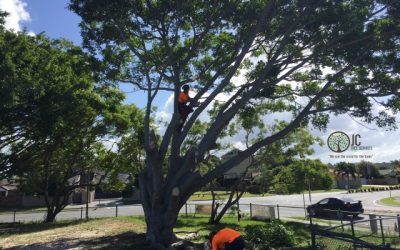
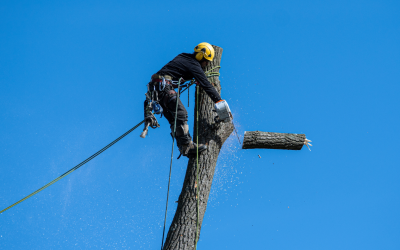
As professional Gold Coast arborists, we see the aftermath of bushfires from a slightly different angle. We don’t fight fires – but we work with:
- The vegetation
- The fuel loads
- And tree structures that can either slow a fire down or help it spread.
We feel that gives us a responsibility to speak up. But this guide isn’t about panic – it’s about preparation. And the kind of preparation you do before the smoke is in the air.
Why preparation matters more than people realise
People often ask how to prepare for a bushfire when fire season begins. The problem is that by the time a fire is nearby, preparation is already too late. Bushfires move fast, change direction suddenly, and overwhelm even well-planned responses if conditions are right.
Preparation isn’t about eliminating risk entirely – it’s about:
- Reducing fuel
- Creating space
- And giving yourself options.
Let’s flesh this out a little more with some practical things to think about now:
1. Reduce fuel around your home (This is critical)
From an arborist’s perspective, unmanaged vegetation is one of the biggest contributors to fire intensity around homes.
All of these are bushfire fuel:
- Dry leaves
- Fallen branches
- Overgrown shrubs
- Dead trees.
Remember, fire doesn’t need a forest to become dangerous – a poorly maintained yard is enough to escalate risk quickly.
Regular pruning, removal of dead limbs, and clearing undergrowth can significantly reduce how intensely fire behaves near structures. Professional tree pruning and vegetation management make a measurable difference in high-risk areas.
2. Create separation between trees & structures
How are your trees? Are they:
- Touching roofs?
- Overhanging gutters?
- Leaning toward buildings?
If so, they’re all major concerns in fire conditions. Because embers don’t need flames to cause damage – they only need something to land on.
One of the most effective things homeowners can do when thinking about how to prepare their house for a bushfire is create clear separation zones between trees and buildings. This reduces ember attack, radiant heat exposure, and the chance of fire jumping directly to your home. In some cases, strategic tree removal is the safest option.
3. Pay attention to palms, dead trees & dense canopies
Certain tree types and conditions pose a higher fire risk. Dead trees, dying branches, and dense canopies trap heat and shed embers more readily.
Palms, in particular, can accumulate dry material high above ground where it’s easily missed – until it ignites. Proper palm tree removal and pruning help reduce this often-overlooked hazard.
Selective pruning and removal isn’t about aesthetics. It’s about reducing ignition points and ladder fuels that allow fire to climb and spread.
4. Don’t forget the bigger picture around your property
Preparation shouldn’t be limited just to your fence line. Always remember that fires have no respect for your property boundaries.
Do you live near:
- Bushland?
- Reserves?
- Unmanaged neighbouring blocks?
If so, it’s worth considering broader vegetation management and having conversations early – not during an emergency. It’s actually a key part of how to prepare for a bushfire in Australia, where many homes sit at the edge of natural landscapes. Larger-scale land clearing can play an important role in reducing overall fuel loads.
5. Understand what ‘prevention’ really means
People often search for how to prevent a bushfire, but the reality is that prevention at an individual level is about mitigation – not control.
What that means is that you can’t stop lightning strikes, extreme heat, or wind – but you can reduce how aggressively fire behaves around your home by managing vegetation and fuel loads properly.
That difference can be the fine line between damage and survival.
6. Prepare the home & the surroundings
Thinking about how to prepare your home for a bushfire isn’t just about the house itself. Common ignition points include:
- Gutters filled with leaf litter
- Decks surrounded by dry material
- Shaded areas that never get cleaned.
Clearing around the home, pruning nearby trees, and removing build-up under structures all reduce your vulnerability. Grinding out old stumps with stump grinding can also prevent dry debris from accumulating at ground level.
7. Prepare yourself – Not just your property
As we said earlier, it really struck us when we heard that survivor warn that “you can’t think straight” when fire is approaching at speed. Panic is all too common – that’s why how to prepare yourself for a bushfire is a question that matters just as much as physical preparation of your home.
So:
- Know your evacuation routes
- Have plans in place early
- Make decisions before the smoke appears.
Don’t forget – fire doesn’t wait for clarity. And it’s well worth repeating over and over again: People just like you often “can’t think straight” once it’s close.
Need expert advice on reducing bushfire risk?
We don’t write this to make you worry, and we don’t write it to sell services – we write it because we’ve seen how quickly conditions change. Unfortunately, preparation is left too late by too many people.
And bushfire readiness isn’t a single task. It’s an ongoing process of awareness, maintenance, and informed decisions. If you’re unsure whether trees on your property pose a risk, JC Tree Services can provide honest, professional advice – with safety and responsibility as the priority.
Give us a call right now or request a free quote for expert arborist guidance across the Gold Coast. Stay safe!