The terms arborist and tree surgeon are often used as if they mean exactly the same thing. Have you been Googling tree surgeon and arborist and ending up more confused than informed? That’s why we’ve sat down to write this blog!
So, first, don’t feel silly – the overlap in language is very real. But so are the differences behind that confusion…
Because most homeowners like you don’t sit around thinking about the professional titles of the tree industry. What you’re thinking about is your trees. Your safety. Your shade. Your properly. Roots lifting paving. A branch hanging over the roof.
And when something feels wrong, you just want the right person to call.
So let’s clear it up properly:
Why the confusion even exists
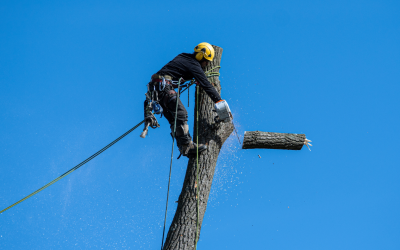
Historically, ‘tree surgeon’ was the common term for someone who climbed trees and performed physical work – pruning, cutting, dismantling, and removing. It’s a phrase that paints a vivid picture – surgery for trees.
‘Arborist‘, on the other hand, comes from arboriculture – the study and management of trees. It’s the formal, industry-recognised term used in qualifications, in council documents, in professional associations. And with our business.
In modern Australia, qualified arborists like us perform what the public would describe as tree surgery. That’s where the crossover and the confusion happen. The key difference isn’t whether someone can use a chainsaw or something – it’s the training, the scope, and the mindset behind that work.
The key differences that actually matter
The gap between the titles becomes clearer when you move past the wording and look at training, decision-making, responsibility – things like that.
1. Education & training
What is an arborist? The answer is about formal study.
A qualified arborist typically holds nationally recognised training in arboriculture. That training covers things like:
- Tree biology
- Structural integrity
- Soil science
- Pest and disease identification
- Pruning standards
- Risk and health assessment
- Safety protocols – and more.
And what is a tree surgeon? The answer is trickier and less connected with formal accreditation. The term itself doesn’t automatically imply a specific qualification level at all. A tree surgeon may be highly skilled and experienced – but the title alone doesn’t confirm structured training in tree science at all.
That distinction matters when you’re making decisions about a living organism that may be decades old.
2. Diagnosis before cutting
One of the clearest practical differences between a tree surgeon and arborist lies in how decisions are made.
An arborist begins by assessing:
- Why is the canopy thinning?
- Is that lean natural or structural?
- Is decay present?
- How will pruning affect future growth?
- Could weight reduction achieve safety without removal?
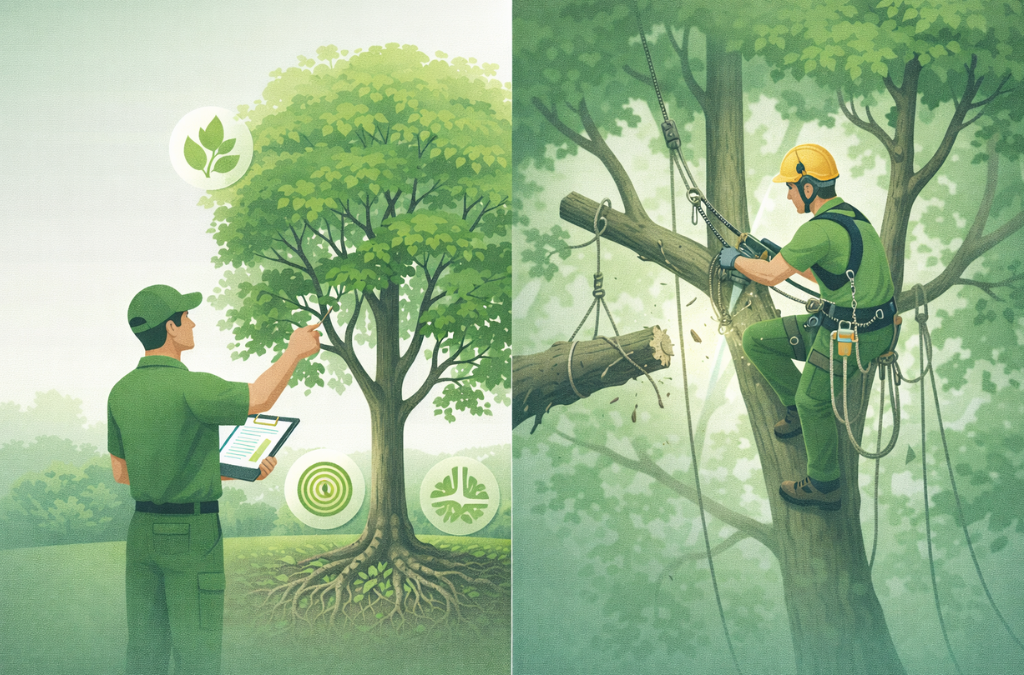
Tree surgery refers more to the physical act of cutting – pruning, shaping, dismantling. It’s the execution stage.
In other words, arboriculture asks “Should we?” before asking “How do we?”
3. Tree health vs task completion
Arborists know very well that trees aren’t static objects. They’re living creatures that respond to intervention.
A poor pruning decision can trigger outcomes like weak regrowth, internal decay, imbalance, or stress. These consequences may not appear immediately – sometimes they only show up years later.
An arborist approaches the work with long-term health in mind. The aim is not just to solve today’s issue, but to leave the tree structurally sound and biologically stable.
Tree surgery, when viewed purely as a service, can become task-focused – reduce the height, clear the roofline, remove the limb. Not much deeper than that.
The best outcomes always happen when practical skill is guided by biological understanding. It’s a crucial difference.
4. Reporting & council compliance
This is where the difference becomes really tangible.
If you need a tree report for council approval, insurance documentation, development planning, or risk assessment, you’re definitely looking for a qualified arborist – not a ‘tree surgeon’. That’s part of the professional scope.
The title ‘tree surgeon’ doesn’t automatically carry that authority – at all. Some individuals using the term may well be qualified arborists – while others may not provide formal reporting services at all.
On the Gold Coast, where tree regulations can be strict, that knowledge and documentation capability is not optional. It’s a must.
5. Industry standards & accountability
Arborists often align with professional associations and recognised pruning standards. Ongoing training, compliance with safety regulations, environmental responsibility – it’s all central to the role as well.
The phrase ‘tree surgeon’ doesn’t inherently communicate that level of professional framework. It may describe the work being done … but not necessarily the regulatory or educational backing behind it.
This is why asking about qualifications is more important than relying on terminology alone.
So … Are they the same?
Not really. In fact, not at all. In everyday conversation, the lines blur a little. And some businesses may well use both terms because that’s what people search for or know about.
In practice, most qualified arborists most certainly perform tree surgery. But not everyone advertising tree surgery is necessarily a qualified arborist.
That’s the honest answer.
The safest approach isn’t to focus on the label – it’s to focus on training, experience, and approach.
So:
- Ask about qualifications.
- Ask how decisions are made.
- Ask whether the goal is preservation, risk management, or removal.
The right professional will be happy to explain – transparently.
Need experienced advice on your trees?
If you’re trying to understand the difference between arborist and tree surgeon, think of it this way:
- Tree surgery is the skilled physical work carried out on trees.
- Arboriculture is the professional discipline that informs how and why that work is done.
When both skill sets are combined properly, your trees – and your property – are in the safest possible hands.
If you’d like experienced advice on your trees, or want to speak with a qualified professional about pruning, removal, or assessment, contact JC Tree Services today. We’re real arborists who are here to give you clear guidance and safe, considered solutions tailored to your property.