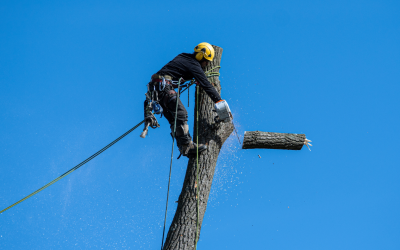
“5 Scenarios where homeowners ask us about tree removal cover”
After a storm, or a close call with a falling branch, or after receiving a council notice about a hazardous tree on your property, you might be wondering: Does home insurance cover tree removal? And if so, exactly when?
Well, the honest answer is that it depends almost entirely on the circumstances. But the bad news is that most of the situations people assume are covered actually aren’t.
We get a lot of questions on this very topic just about every single week – so we’ve put together a clear breakdown of the 5 scenarios Gold Coast homeowners like you encounter the most. We also explore what insurance typically does and doesn’t pay for in each situation.
What to understand upfront
Before we dive into the details, it’s important to understand that home insurance in Australia is designed to cover sudden, unexpected events – not maintenance, not prevention, and not the natural lifecycle of trees on your property.
That distinction is the lens through which every scenario below should be read. And there is some good news here – because if the situation genuinely involves something that happened suddenly, caused damage to an insured structure, and falls within your policy’s definition of a covered event, there’s a reasonable chance of a claim.
But if it involves:
- A tree that’s been slowly dying
- A tree that’s growing too close to the house
- A tree that’s simply become inconvenient …
Then home insurance is almost certainly not going to bail you out here.
However: policy wording varies significantly between insurers. So the 5 scenarios we’ve put together should be regarded as a general guide based on how most Australian home insurance policies operate. It’s certainly not a substitute for reading your own policy or speaking with your insurer directly.
Now let’s dive into the 5 scenarios we’ve been harping on about:
1. A storm brings a tree down onto your house
Let’s start with the big one – the scenario where home insurance is most likely to respond. But even here, the coverage is more specific than most people assume.
If a tree falls onto an insured structure during a storm and causes damage, most home insurance policies will cover the repair to the structure and the removal of the tree or debris that’s in direct contact with it.
The key phrase here is ‘insured structure’. The policy is responding to the structural damage – the tree removal is covered as part of clearing that damage, not as a standalone service.
If the same tree falls during the same storm and lands entirely on the lawn without touching the house, the garage, or any other insured structure, most policies won’t cover removal at all. No structural damage means no claim trigger – which means the tree sits there at your expense.
2. A tree falls and blocks your driveway or access
A fallen tree blocking access to the property feels like an emergency – and it is, practically speaking.
But whether home insurance covers removal in this scenario depends heavily on the specific policy. Some insurers include emergency access provisions that cover removal where a fallen tree is preventing entry to the home. Many don’t.
So it’s one of the scenarios where calling your insurer before calling anyone else is genuinely worthwhile, because the answer really varies.
3. A tree on your property is dead, diseased, or clearly hazardous
Now for a scenario in which most Gold Coast homeowners get the answer they weren’t hoping for.
Are you dealing with:
- A dead tree?
- A tree that’s showing signs of disease?
- A tree that’s grown to a size and position that makes it a genuine risk to the property?
Bad news here – none of these are covered by home insurance for removal. Insurers classify this as a maintenance issue – and maintenance is explicitly excluded from virtually every home insurance policy in Australia.
The logic from the insurer’s perspective is straightforward, and fairly understandable:
- The risk was known
- The risk was pretty obvious
- The risk was reasonably manageable before it became a claim.
So it’s important to remember that home insurance doesn’t exist to subsidise maintenance that you’ve put off – it’s there to cover events that couldn’t reasonably have been anticipated or prevented in any way at all.
So does home insurance help with tree removal in this scenario? No.
Therefore, it’s exactly the situation where engaging a qualified arborist proactively is the right move – before the tree becomes the storm situation from scenario 1!
4. Your neighbour’s tree falls onto your property
Read this one carefully, because it surprises a lot of people:
If a neighbour’s tree falls onto your property and damages your home, you generally claim on your own home insurance – not your neighbour’s. Whether your neighbour has any liability depends on whether they were aware of a known hazard and failed to act on it – which is a legal question rather than an insurance one, and not straightforward to pursue.
In practice, most homeowners in this situation make a claim under their own policy for structural damage and move on. So does home insurance pay for tree removal in this scenario ever? Potentially … as part of a structural damage claim. Same rules as scenario 1, basically.
5. A council notice requires you to remove a tree
Receiving a notice from Gold Coast City Council requiring removal of a tree on your property is not a covered insurance event. It’s a regulatory requirement, and the cost of compliance sits with the property owner.
This applies whether the notice relates to a protected species, or an encroachment issue, or even a tree that’s been identified as a risk during a council inspection. Home insurance does not cover tree removal Gold Coast council notices trigger – full stop.
What this means in practice
You may have noticed that the pattern across all five scenarios is consistent: home insurance responds to sudden events that cause damage to insured structures.
And it doesn’t cover:
- Proactive removal
- Maintenance-related removal
- Removal required by regulation.
For the vast majority of tree removal situations Gold Coast homeowners face – like a tree that’s died, or grown too large, or been storm-damaged without hitting the house, or been flagged by council – the cost is yours to manage.
The smarter approach – and the one that protects both the property and the budget – is not to wait for an insurable event. A dead or structurally compromised tree that comes down in the next storm and hits the roof will trigger a claim – but the roof damage, the stress, and the emergency call-out costs that come with it are all avoidable.
Talk to a qualified arborist first
JC Tree Services has been assessing and removing trees across the Gold Coast for over 30 years. If you have a tree on your property that’s causing concern – whether it’s dead, diseased, storm-damaged, or simply too close to the house for comfort – we provide free quotes and honest advice about what needs to happen and when.
Call or get in touch online for your free assessment today.